
EnzymeRSI: A Recursive Self-Improving System for Enzyme Engineering
PAPER EXPLAINER · ENZYMERSI
Directed evolution turned build–test–select into a repeatable engineering workflow, and machine learning gave the question of what to assay next an evidential basis. But how many samples one round of wet-lab work can process, and how long that round takes, determine how often a method can be tested at all — choosing the right thing to measure matters more than measuring more.
Recent work shares one assumption: the method itself is fixed. It optimises which candidates to assay, not the method used to judge which candidates to assay. A second fact has gone unmanaged alongside it: the same foundation model performs very differently under different forms of organisation — prompts, workflows, tool access, subtask division — and that layer has never been treated as an object of evaluation in its own right.
Each half is missing something: the first fixes the method, the second is never scored. EnzymeRSI puts them together, making the algorithm and the organisation of research both evolvable objects that can be evaluated, adopted or rolled back.
EnzymeRSI was tested against all three on real enzymes: cold start on RLuc, trade-off on A3A, path on KOD-E. All three candidate lists were frozen before wet-lab measurement, so the results are prospective rather than selected after the fact. All three returned positives — and RLuc also exposed a gap that is not yet closed: the system picks a good batch but cannot rank within it.
What follows walks through how each of the two layers works, the ledger each keeps, and the full results on the three enzymes.
01 | Two loops, two separate ledgers
The split exists so that improvement can be attributed. Under a single combined score, gains in method and gains in organisation mask one another — the number goes up, but nobody can say which layer earned it. So the protein, algorithm and system tiers are each scored on their own.
The outer loop may rewrite prompts, pipelines, skills and subagents; model weights are never touched. Every round is compared against a control version on the same assay, and anything that fails the gate is rolled back. The inner loop is not always running — only when the outer loop hits a method bottleneck is it triggered, to change representation, modelling and training recipe: the foundations.
02 | Of 142 paired comparisons, 12 were adopted
Most of the time this system says no.
- rounds
- 196
- paired comparisons
- 142
- adopted
- 12
- adoption rate
- 8.5%
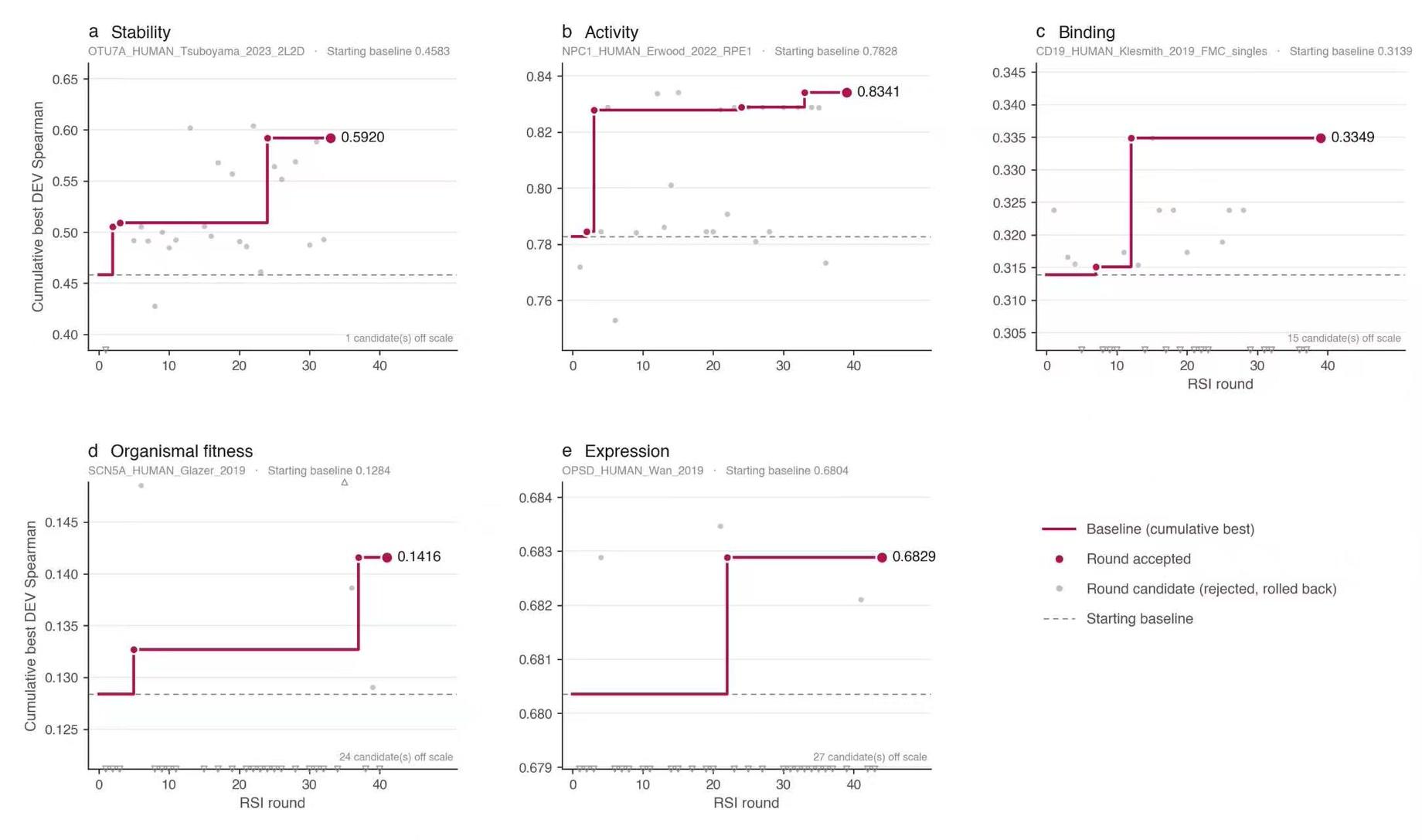
Paper Fig. 3 The step rises only on adoption; every grey dot is a rolled-back candidate. Panel c (binding) shows the jump at round 12. The gate uses spearman_macro with a minimum acceptable increment of 0.001, and the adoption rule is fixed before the comparison. Figures keep the colours of the original paper.
Of the two first places, the evolution earned one
A mean gain of 0.044 across the five assays. The first place on antibody binding (CD19) was earned by the evolution; the one on expression (OPSD) was not.
| What the assay tests | Start | End | Official best | Source |
|---|---|---|---|---|
| Antibody binding · CD19 (FMC63 mAb; the panel ranks 3,761 variants) | 0.314 | 0.335 | 0.316 | 2 adoptions over 39 rounds (gain concentrated in one change to the variant input at round 12) |
| Expression · OPSD (starting point already above the leader) | 0.680 | 0.683 | 0.656 | 44 rounds contributed 0.003 (the first place comes from the starting tool combination) |
Development-set results · against the 97 published models in the official ProteinGym record · single-assay basis
03 | Ten frameworks on the same task; two touched the representation
Same task, same split, same starting point, same scorer. The gain coincides with the deliberate introduction of ESM2 representations.
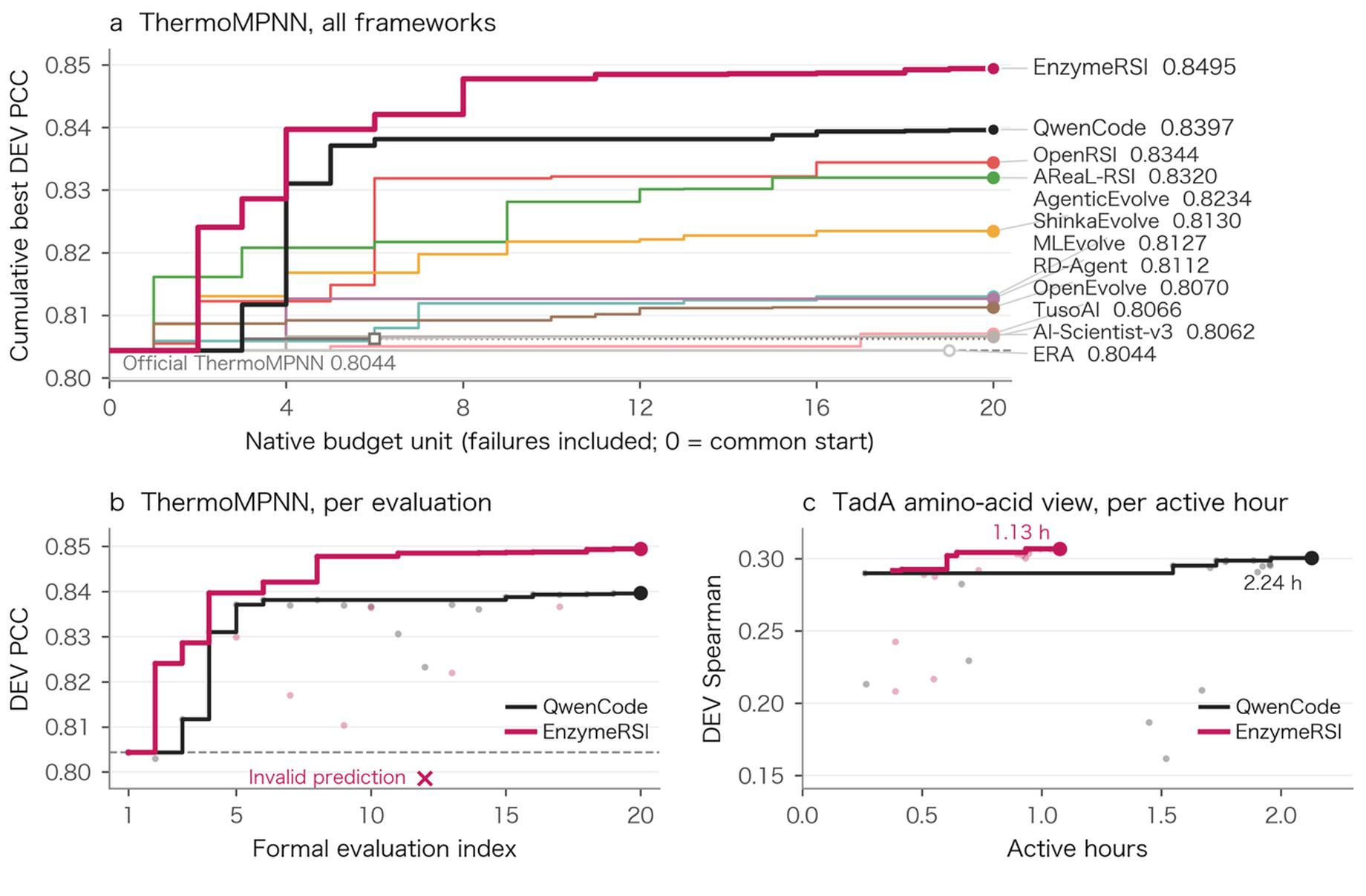
Paper Fig. 2 The horizontal axis is each framework's own budget unit, so it is not a comparison of compute. One run each, development-set results. Of the ten reference frameworks only MLEvolve also moved the representation; the highest, OpenRSI, left it unchanged and reached 0.8344 with a ten-member ensemble. Some frameworks returned candidates that were exact affine transforms of the official prediction — Pearson correlation is invariant to those, so the score stayed at the start. Panel c is TadA, with active hours on the axis.
- official start
- 0.8044
- unmodified run
- 0.8397
- EnzymeRSI
- 0.8495
TadA: a different way of modelling — and faster
The task is to predict the next round's activity ranking from rounds already completed. The difficulty is a mismatch between training data and evaluation target — the early-round supervision says which substitutions inactivate the enzyme, while every candidate to be ranked is alive. The fix was to replace continuous regression with ordinal modelling over activity bands. The unmodified run ported a dozen model architectures and stopped at 0.3007; ours reached 0.3068 in 1.13 h against 2.24 h.
20 formal evaluations on both sides, one run each, development-set results. For RSI a faster round means more rounds in the same wall-clock time — but the point does not generalise: on ThermoMPNN our run took 2.54 h against 1.60 h, and that task is judged on score, not speed.
04 | Three enzymes, one question each
Nominated first, measured after. Cold start, trade-off, path — there is no single right answer across the three, and the optimum moves with the objective.
RLuc · Cold start: a good batch, but no reliable ranking
The nomination stage used only single-point measurements from the literature plus sequence and structural information, and the design record was frozen before any wet-lab measurement. Of the 40 single substitutions, 8 were pre-specified RLuc8 components; among the remaining 32 candidates, 10 reached at least twice the same-plate wild type. But within-pool ranking is nearly uncorrelated, ρ = 0.175 — a gap named as a trigger for the inner loop and not yet closed.
A3A · Trade-off: move one limit and the top choice changes
A hard constraint caps the loss of unmodified C; candidates are then ranked by 5mC conversion in the weaker context. At limits of 10% / 50% / 60% the eligible sets are 6 / 18 / 24 variants, and the top choice is Y132C / Y130Q / K47T respectively.
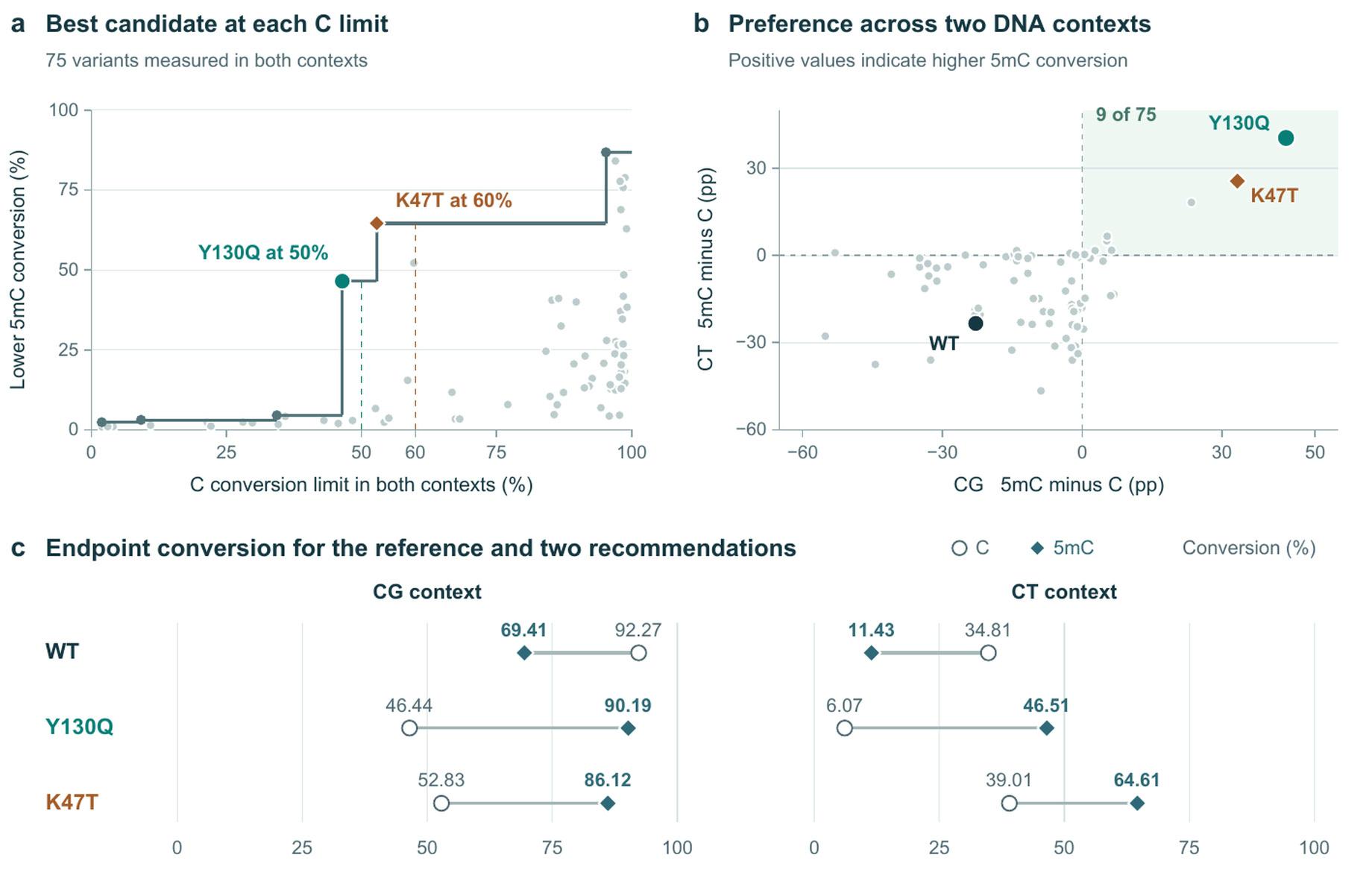
Paper Fig. 5 The step in panel a is the optimum jumping with the constraint; the two dashed verticals mark where the top choice changes at the 50% and 60% limits. Scope: the rule was generated and applied on the same 75 measured variants, so this shows how the optimum moves with the constraint, not ranking power over unmeasured variants.
KOD-E · Path: the last step rewrites the next one’s payoff
The parent E485I itself reaches 2.9-fold; adding S451L jumps to 31.1-fold, while R484G falls back to 1.2-fold — both branches were assayed. The landscape is defined by 189 single-substitution variants, 45 of them with E485I as parent; contact surfaces in the crystal structure account for the rank reversal between positions 676 and 680.
Boundaries of these three cases
- The three-enzyme work was carried out by the experimental team; EnzymeRSI supplied the candidate nominations and the selection rules.
- The experiments ran in a cloud-laboratory environment; sample identities, execution records, raw files and QC outcomes were linked before downstream analysis.
- These experiments tested single-round decision and execution support; they did not constitute a multi-round campaign in which the recursive-improvement loops autonomously commissioned and adapted successive experimental rounds.
05 | The dual loop runs inside the World Loop
ProtoPilot expands a research goal into an executable protocol, Operon-S1 makes the fast decisions wherever the criteria are clear, and EnzymeRSI decides what to change and what to measure next. Once a researcher confirms, the cloud autonomous lab executes. Results return together with their experimental conditions and QC status.
Back to the question this started with. What the system hands over is not a handful of scores but a record you can check line by line: what was proposed in each round, what it was compared against on the same assay, whether it passed the gate, and whether it was adopted or rolled back. The feedback does not come from a fixed benchmark — it comes from the physical world.
06 | Read the full study
EnzymeRSI: A Recursive Self-Improving System for Enzyme Engineering, arXiv:2611.06321.
@article{enzymersi2026,
  title   = {EnzymeRSI: A Recursive Self-Improving System for Enzyme Engineering},
  author  = {Hou, Yuejie and Yang, Lixiang and Liu, Yisi and
             Tang, Weiting and Yang, Yueyuxiao and Yang, Meng},
  journal = {arXiv preprint arXiv:2611.06321},
  eprint  = {2611.06321},
  year    = {2026}
}